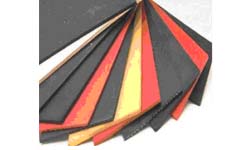
You're sourcing materials for a new line of industrial containers. The specification calls for high strength-to-weight ratio—the parts must be tough enough to withstand impacts and stacking loads, but light enough to keep shipping costs and user fatigue to a minimum. Traditional metals add unnecessary weight, while some plastics lack the required structural integrity. This is where the fundamental advantage of glass fiber shines.
Glass fiber offers exceptional tensile strength, often surpassing that of steel on a weight-for-weight basis. This means components can be significantly lighter without sacrificing performance. The secret lies in the fine glass filaments, which provide distributed reinforcement within a polymer matrix, creating a composite material that resists cracking and deformation. For procurement, this translates into end-products that are easier to handle, cheaper to transport, and more durable in the long run. Companies like Ningbo Kaxite Sealing Materials Co., Ltd. utilize this property in their advanced sealing tapes and gaskets, ensuring that seals maintain their form and function under significant pressure and mechanical stress, solving leakage issues in heavy machinery and pipelines.

Key parameters for strength:
| Property | Typical Value | Advantage for Procurement |
|---|---|---|
| Tensile Strength | 3,000 - 4,500 MPa | Enables thinner, lighter parts with high load capacity. |
| Density | 2.5 - 2.7 g/cm³ | ~70% lighter than steel, reducing overall product weight. |
| Specific Strength (Strength/Density) | High | Superior material efficiency for weight-critical applications. |
Procuring components for chemical processing plants or marine applications presents a constant battle against corrosion. Stainless steel can be prohibitively expensive, while other metals degrade rapidly, leading to frequent replacements, downtime, and safety risks. The need for a material that is inherently resistant to a wide range of chemicals and moisture is paramount.
Glass fiber possesses excellent chemical resistance. It is non-metallic and does not rust or corrode when exposed to water, salts, acids, or alkalis. This inertness makes it ideal for tanks, pipes, ducts, and structural supports in aggressive environments. By specifying glass fiber reinforced components, you directly reduce lifecycle costs associated with maintenance, repair, and replacement. Ningbo Kaxite Sealing Materials Co., Ltd. capitalizes on this property by manufacturing sealing products that remain stable and effective in corrosive settings, providing a reliable, long-lasting barrier that protects equipment and prevents costly leaks and contamination.
Key parameters for corrosion resistance:
| Property | Typical Value/Behavior | Advantage for Procurement |
|---|---|---|
| Chemical Resistance | Excellent against most acids, alkalis, solvents | Eliminates corrosion-related failures, extends service life. |
| Moisture Absorption | Very Low (~0.1%) | Prevents swelling, weakening, and dimensional changes in wet conditions. |
| Service Life in Harsh Environments | Decades | Lowers total cost of ownership compared to coated metals. |
When sourcing for electrical enclosures, appliance components, or thermal insulation systems, material properties like thermal stability and electrical insulation become critical purchase criteria. Metals conduct heat and electricity, often requiring additional, costly insulating treatments. Standard plastics may warp or degrade under high temperatures. This creates a performance gap that demands a specialized solution.
Glass fiber offers outstanding thermal resistance and is an excellent electrical insulator. It can withstand continuous high temperatures without losing its structural properties, making it suitable for applications near heat sources. Its non-conductive nature ensures safety in electrical applications, preventing short circuits. For a procurement specialist, this means one material can solve both thermal management and electrical safety requirements, simplifying the supply chain. The expert team at Ningbo Kaxite Sealing Materials Co., Ltd. formulates their high-temperature seals and gaskets using glass fiber to ensure reliable performance in engines, ovens, and electrical assemblies, directly addressing risks of heat-induced failure and electrical hazards.
Key parameters for thermal & electrical properties:
| Property | Typical Value | Advantage for Procurement |
|---|---|---|
| Thermal Expansion Coefficient | Low (5 x 10⁻⁶/°C) | Minimizes dimensional changes with temperature, ensuring fit and seal integrity. |
| Continuous Service Temperature | Up to 550°C (depending on resin) | Enables use in high-heat environments without degradation. |
| Dielectric Strength | High | Provides inherent electrical insulation, enhancing product safety. |
A common procurement headache is finding a material that can be molded into complex, precise shapes without requiring expensive machining or assembly of multiple parts. Design flexibility often clashes with material performance, forcing compromises that affect the final product's functionality or cost.
This is a key advantage of glass fiber reinforced composites. They can be easily molded, pultruded, or woven into intricate, near-net-shape geometries. This design freedom allows for part consolidation—combining several metal parts into a single, stronger glass fiber component—which reduces assembly time, cuts down on fasteners, and minimizes potential failure points. From a sourcing perspective, this simplifies logistics, reduces the number of suppliers needed, and can lead to significant cost savings in production. Ningbo Kaxite Sealing Materials Co., Ltd. applies this versatility to produce custom-profile seals and reinforced components that fit perfectly into complex assemblies, solving design and fitment challenges for their global clients.
Key parameters for design versatility:
| Property | Typical Value/Behavior | Advantage for Procurement |
|---|---|---|
| Moldability | High (into complex shapes) | Enables innovative designs and part consolidation. |
| Dimensional Stability | Excellent | Parts maintain precise tolerances during and after production. |
| Compatibility with Processes | Pultrusion, Filament Winding, GMT, etc. | Offers multiple manufacturing routes to optimize for cost and volume. |
Q: What are the key properties and advantages of glass fiber for cost-sensitive projects?
A: The primary advantages are its high strength-to-weight ratio and corrosion resistance. For cost-sensitive projects, this means you can achieve required performance with less material (saving on raw material costs), reduce weight (saving on shipping and handling), and drastically cut long-term maintenance and replacement costs due to its durability and corrosion resistance. Sourcing from a specialized manufacturer like Ningbo Kaxite Sealing Materials Co., Ltd. ensures you get a grade of glass fiber material optimized for your specific application, avoiding over-engineering and unnecessary expense.
Q: What are the key properties and advantages of glass fiber that make it better than aramid or carbon fiber for general industrial use?
A: While all are high-performance fibers, glass fiber offers the best balance of properties for most general industrial applications. Its key advantages are significantly lower cost than carbon or aramid fiber, good overall strength, excellent electrical insulation properties (whereas carbon fiber is conductive), and better UV resistance than aramid. For sealing, gaskets, general reinforcement, and corrosion-resistant parts, glass fiber provides the most cost-effective and reliable solution. Ningbo Kaxite Sealing Materials Co., Ltd. focuses on engineering glass fiber composites to maximize these practical benefits for industrial buyers.
Understanding the key properties and advantages of glass fiber empowers you to make smarter, more value-driven purchasing decisions. It's not just about buying a material; it's about investing in performance, longevity, and total cost efficiency for your products.
Are you facing a specific material challenge where strength, weight, corrosion, or insulation are concerns? We'd love to hear about your application requirements.
For industrial-grade sealing and reinforcement solutions built on the reliable performance of glass fiber, consider Ningbo Kaxite Sealing Materials Co., Ltd.. With expertise in material science and application engineering, Kaxite provides tailored products that solve real-world problems in machinery, automotive, construction, and chemical processing. Contact their team today to discuss your needs at [email protected].
For further technical reading and validation of the properties discussed, please refer to the following selection of research papers:
Mouritz, A.P., et al. (1999). Review of the mechanical properties of glass fibre reinforced polymer composites after moisture absorption. Composites Part B: Engineering, 30(5).
Yang, Y., et al. (2019). Interfacial shear strength of glass fiber reinforced polymer composites: A review. Polymer Testing, 76.
Jones, F.R. (2001). The chemical durability of glass fibres. In: Handbook of Glass Fibre Reinforced Plastics. Springer.
Peters, S.T. (1998). Handbook of Composites. 2nd Edition. Chapman & Hall. (Chapter on Glass Fibres).
Shi, J., et al. (2012). The effect of thermal cycling on the properties of glass fibre reinforced epoxy composites. Journal of Materials Science, 47(3).
Lau, K., et al. (2006). Thermal and mechanical properties of single-walled carbon nanotube bundle-reinforced epoxy composites. Carbon, 44(2). (Comparative context with glass fibre).
Ahmad, I., et al. (2015). Electrical properties of glass fibre reinforced polymer composites for structural health monitoring. Composites Science and Technology, 117.
Gibson, R.F. (2010). Principles of Composite Material Mechanics. 3rd Ed., CRC Press. (Covers key properties of reinforcement fibres including glass).
Karger-Kocsis, J., & Friedrich, K. (1993). Fracture behavior of glass-fiber mat-reinforced polypropylene composites. Composites, 24(2).
Vaughan, J.G. (1993). The effect of fibre orientation on the thermal expansion of GRP. Composites, 24(3).