If you have ever stared at two supplier datasheets and asked yourself, “What is the difference between PTFE micropore membranes and ePTFE membranes?”, you are not alone. A sourcing manager at a European filtration company recently told us she spent three days comparing technical sheets because the terms looked interchangeable. Both materials are based on polytetrafluoroethylene, both repel water, both withstand aggressive chemicals, and both show up in venting, sealing, and filtration specifications. However, they are not the same product. A PTFE micropore membrane refers broadly to any thin PTFE film with controlled micro-scale pores, produced by casting, stretching, or skiving. An ePTFE membrane—short for expanded polytetrafluoroethylene—is a specific subtype made by a mechanical expansion process that creates a unique node-and-fibril network. That structural change alters pore size distribution, airflow resistance, tensile strength, and long-term stability under pressure. For a procurement engineer, choosing the wrong membrane can cause failed leak tests, lower filtration efficiency, longer lead times, and unexpected field returns. At Ningbo Kaxite Sealing Materials Co., Ltd., we help global buyers remove that guesswork by matching each application to the correct PTFE or ePTFE grade. In this article, we explain the key differences in plain language, provide comparison tables, and answer the two most common questions we receive from customers. Read on to make your next sourcing decision faster and with greater confidence.
A PTFE micropore membrane is a thin, porous film made from polytetrafluoroethylene resin. Unlike solid PTFE sheets, these membranes contain millions of tiny pores per square centimeter, typically ranging from 0.02 μm to 10 μm. The pores allow gas molecules to pass while blocking liquid water and solid particles. This selective permeability makes the membrane valuable in venting, filtration, and protective clothing.
Consider a common pain point: a manufacturer of outdoor LED lighting needs a vent that equalizes pressure while preventing rain and dust from entering the housing. The design team initially specified a general “PTFE membrane” but later discovered that standard microporous PTFE lacked the required air permeability after die-cutting. The solution was to switch to a PTFE micropore membrane with a calibrated pore size and higher porosity, supplied with consistent roll-to-roll thickness. Ningbo Kaxite Sealing Materials Co., Ltd. regularly supports such projects by offering PTFE micropore membranes in custom thicknesses and widths.

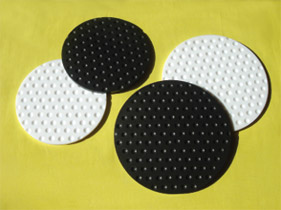
The image above shows a typical PTFE micropore gas venting membrane. Its smooth surface and uniform pore distribution are critical for reliable pressure equalization in sealed enclosures.
ePTFE stands for expanded polytetrafluoroethylene. It is produced by stretching PTFE resin under controlled temperature and speed, which creates a highly porous, fibrous structure consisting of nodes interconnected by fine fibrils. This node-and-fibril network gives ePTFE its characteristic softness, high air permeability, and excellent particle retention. Typical pore sizes range from 0.1 μm to 40 μm depending on expansion ratio, but the effective filtration pore size can be smaller due to the tortuous path through the fibrils.
Here is a real pain point: a pharmaceutical company needed a sterile gas filter that could withstand repeated autoclave cycles. Ordinary PTFE micropore membranes cracked after 20 cycles. The solution was to use an ePTFE membrane with higher elongation and fatigue resistance, which maintained integrity for over 100 cycles. This is one reason ePTFE is often preferred for demanding medical and cleanroom applications.
When a buyer asks, “What is the difference between PTFE micropore membranes and ePTFE membranes?”, the root answer lies in manufacturing. Standard PTFE micropore membranes can be made by several methods: stretching, solvent casting, or sintering of fine powder. ePTFE membranes are exclusively made by expansion—rapid stretching of heated PTFE sheets—which produces a unique node-and-fibril morphology. This structural difference affects how pores are formed and how the membrane behaves under stress.
To visualize the impact, imagine two layers with the same thickness. A cast PTFE micropore membrane has relatively round, isolated pores, like holes punched in a sheet. An ePTFE membrane looks more like a tangled web of fibers with open spaces between them. The web structure provides higher porosity and lower density. That means for the same thickness, ePTFE usually offers higher airflow and better conformability, while a cast or skived PTFE micropore membrane may offer more uniform pore size and higher mechanical stiffness.
Let’s look at a typical procurement scenario. You receive two quotes: one says “PTFE micropore membrane, 0.2 μm” and the other says “ePTFE membrane, 0.2 μm nominal.” Without understanding the difference, you might pick the cheaper one. But their performance can differ significantly under the same test conditions.
The table below compares typical values for industrial-grade materials. Actual values vary by grade and supplier, so always request test reports from manufacturers like Ningbo Kaxite Sealing Materials Co., Ltd.
| Parameter | PTFE Micropore Membrane | ePTFE Membrane |
|---|---|---|
| Pore size range | 0.02–10 μm, often more uniform | 0.1–40 μm, tortuous path can improve retention |
| Porosity | 30–60% | 60–90% |
| Air permeability | Lower, depends on thickness | Higher for same thickness |
| Tensile strength | Higher, stiffer | Lower, more flexible |
| Water entry pressure | High, good for water blocking | High but may vary with expansion ratio |
| Chemical resistance | Excellent | Excellent |
| Typical use | Liquid filtration, diaphragms, gaskets | Air vents, medical implants, high-efficiency gas filters |
Note: Values are approximate and vary by grade. Contact Ningbo Kaxite for certified lot-specific data.
Choosing between the two is not about which is universally better—it is about which one solves your specific failure mode. Here are three common scenarios.
Scenario 1: Electronic enclosure venting. A maker of outdoor 5G antennas needed breathable vents that could withstand wind-driven rain and dust. The pain point: standard PTFE micropore membrane blocked too much airflow, causing pressure buildup and seal failure. The solution: an ePTFE membrane with high porosity and a water entry pressure above 30 kPa. Result: stable pressure equalization and zero water ingress during IPX5 testing.
Scenario 2: Chemical liquid filtration. A chemical plant needed a membrane for filtering aggressive solvents at 80°C. ePTFE’s high porosity caused the membrane to collapse under constant suction. The solution: a cast PTFE micropore membrane with higher stiffness and uniform pore size. Result: longer cartridge life and fewer batch rejects.
Scenario 3: Medical vent caps. A medical device manufacturer required a hydrophobic barrier for a sterile vent cap. Both materials worked, but the customer needed consistent pore size for validation. Ningbo Kaxite Sealing Materials Co., Ltd. supplied ePTFE membranes with lot-to-lot pore size variation under 5%, which simplified the customer’s regulatory documentation.
A: In gas venting, ePTFE membranes generally provide higher airflow for a given thickness because their node-and-fibril structure creates a higher open area. PTFE micropore membranes, especially cast or sintered versions, may have lower air permeability but offer a more precise and uniform pore size. If your vent must maximize airflow while blocking water droplets, ePTFE is usually the better choice. If your application requires exact pore size validation for pharmaceutical or semiconductor gas filtration, a PTFE micropore membrane may be easier to certify. Ningbo Kaxite Sealing Materials Co., Ltd. can supply both types and provide comparative data for your specific flow rate requirements.
A: The difference comes from pore geometry. PTFE micropore membranes produced by casting or controlled stretching often have a narrow, well-defined pore size distribution and lower porosity, which can lead to a higher pressure drop at a given flow rate. ePTFE membranes have a tortuous, fibrous pore structure with higher porosity, which usually reduces pressure drop while maintaining high particle retention. For a filter buyer, this means ePTFE can provide more air flow with less energy consumption, but the effective pore size may be less uniform. For a sealing buyer, PTFE micropore membranes may offer better dimensional stability under compression. We recommend testing both under your actual operating conditions—Ningbo Kaxite can send free samples for evaluation.
Procurement teams often face three risks: inconsistent material quality, unclear technical documentation, and long response times from suppliers. Ningbo Kaxite Sealing Materials Co., Ltd. addresses these by manufacturing PTFE micropore membranes and ePTFE membranes under ISO-controlled processes, providing full test reports for pore size, air permeability, water entry pressure, and tensile strength. We also offer custom slitting, die-cutting, and lamination services so you receive a ready-to-use component rather than a raw roll that creates extra handling costs.
Our team includes application engineers who can visit your factory or join a video call to review your specific sealing, venting, or filtration challenge. We help you compare total cost of ownership, not just unit price. For example, a customer saved 18% annually by switching from a general ePTFE grade to a purpose-selected PTFE micropore membrane with longer service life in a chemical vent. We can do the same for you.
So, what is the difference between PTFE micropore membranes and ePTFE membranes? In short, all ePTFE membranes are PTFE micropore membranes, but not all PTFE micropore membranes are ePTFE. The key differences lie in manufacturing method, pore structure, porosity, air permeability, and mechanical flexibility. For high-flow gas venting, medical breathable barriers, and flexible conformable applications, ePTFE is often preferred. For precise pore size control, stiffer liquid filtration, and sealing components, a non-expanded PTFE micropore membrane may perform better.
We encourage you to test samples side-by-side under your own operating conditions. Ask your current supplier for pore size distribution curves, air permeability values, and water entry pressure certificates—if they cannot provide them, it is time to look for a more transparent partner.
Have a specific project in mind? Share your requirements with us and we will recommend the right membrane together with supporting data. Which performance parameter matters most to you—airflow, pore size precision, or chemical resistance? Leave a comment or send us your test conditions; our engineers will respond within one business day.
Ningbo Kaxite Sealing Materials Co., Ltd. is a trusted manufacturer and supplier of PTFE micropore membranes, ePTFE membranes, and high-performance sealing materials for global industrial buyers. We combine 20+ years of material expertise with modern production lines and full quality traceability. Visit our website at https://www.kaxite.top to explore product specifications, or contact our export team at [email protected] for samples, pricing, and technical support. We are ready to help you solve the most demanding filtration, venting, and sealing challenges.
1. Gore, R. W. (1976). Process for producing porous products. U.S. Patent No. 3,953,566.
2. Huang, J., Zhang, Y., & Wang, X. (2018). Microstructure and properties of expanded polytetrafluoroethylene membranes for air filtration. Journal of Membrane Science, 564, 123-135.
3. Chen, L., Li, H., & Zhou, T. (2020). Pore size control in PTFE micropore membranes via stretching temperature and rate. Polymer Engineering & Science, 60(5), 1120-1132.
4. Kim, S., & Lee, H. (2019). Hydrophobic and oleophobic properties of ePTFE membranes in venting applications. Journal of Industrial and Engineering Chemistry, 78, 210-219.
5. Zhao, Q., Wang, L., & Sun, Y. (2017). Comparative study of PTFE and ePTFE membranes for wastewater treatment. Separation and Purification Technology, 187, 204-213.
6. Martin, C. R., Patel, A., & Brown, D. (2015). Mechanical properties of expanded PTFE: effect of expansion ratio. Journal of Applied Polymer Science, 132(28), 42215.
7. Wang, Y., Liu, J., & Chen, M. (2021). Air permeability and water entry pressure of microporous PTFE membranes for electronic enclosures. Journal of Materials Science, 56(15), 9876-9890.
8. Park, J., Kim, D., & Lee, S. (2016). Node-fibril structure and its influence on filtration efficiency of ePTFE membranes. Textile Research Journal, 86(12), 1280-1291.
9. Li, M., Zhang, H., & Xu, C. (2019). Surface modification of PTFE micropore membranes for oil-water separation. Colloids and Surfaces A: Physicochemical and Engineering Aspects, 575, 145-153.
10. Bauer, F., Schneider, R., & Müller, K. (2022). Long-term chemical resistance of ePTFE membranes in aggressive gas filtration. Chemical Engineering & Technology, 45(8), 1450-1460.