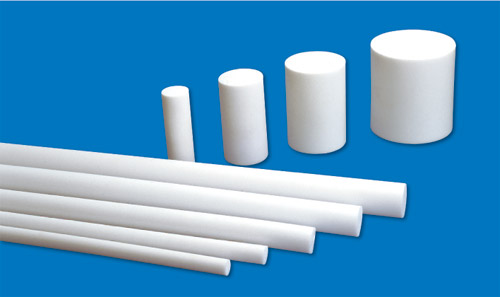
PTFE Rod, also known as Teflon® rod or polytetrafluoroethylene rod, is a high-performance engineered plastic material renowned for its exceptional chemical resistance, low coefficient of friction, and outstanding electrical insulating properties. As a cornerstone material in demanding industrial applications, it serves critical functions in sealing, insulating, bearing, and guiding components across numerous sectors, including chemical processing, food and beverage, pharmaceutical, semiconductor, and automotive industries. Kaxite Sealing, with decades of expertise in advanced polymer solutions, manufactures premium-grade PTFE rods that meet the most rigorous standards for performance and reliability.
The superiority of PTFE stems from its unique molecular structure, a long chain of carbon atoms surrounded by fluorine atoms. This structure creates an incredibly stable and inert material. It is virtually unaffected by most chemicals, operates effectively across a wide temperature range, and remains stable in both high-humidity and dry environments. For engineers and procurement specialists, selecting the right PTFE rod requires a detailed understanding of its technical parameters to ensure optimal performance in the intended application.
### Key Parameters and Properties of PTFE Rods
To specify a PTFE rod accurately, the following parameters must be considered. Kaxite Sealing provides comprehensive data for each batch, ensuring full traceability and quality assurance.
**Material Composition & Grades:**
* **Virgin PTFE:** Manufactured from 100% pure PTFE resin without additives. Offers the highest purity, best chemical resistance, and excellent dielectric properties. Ideal for semiconductor and high-purity fluid handling.
* **Reinforced PTFE:** PTFE compounded with fillers like glass fiber, carbon, graphite, or bronze to enhance specific mechanical properties.
* **Glass-Filled PTFE:** Improved compressive strength, wear resistance, and dimensional stability. Reduced cold flow.
* **Carbon/Graphene-Filled PTFE:** Enhanced conductivity (electrical/thermal), superior wear resistance, and lower deformation under load.
* **Bronze-Filled PTFE:** Greatly increased thermal conductivity, compressive strength, and wear resistance for heavy-duty bearing applications.
* **FDA-Compliant / USP Class VI PTFE:** Specially formulated and processed rods that meet stringent food, medical, and pharmaceutical contact regulations.
**Physical & Mechanical Properties Table:**
| Property | Standard Value (Virgin PTFE) | Test Method | Impact on Application |
| :--- | :--- | :--- | :--- |
| **Density** | 2.14 - 2.20 g/cm³ | ASTM D792 | Indicates material purity and consistency. |
| **Tensile Strength** | 20 - 35 MPa (2900 - 5000 psi) | ASTM D638 | Resistance to pulling forces; important for structural parts. |
| **Elongation at Break** | 300 - 500% | ASTM D638 | High ductility and ability to deform without cracking. |
| **Compressive Strength** | 12 - 20 MPa (1700 - 2900 psi) | ASTM D695 | Resistance to crushing or deforming under load. |
| **Hardness (Shore D)** | 50 - 65 | ASTM D2240 | Surface resistance to indentation. |
| **Coefficient of Friction (Dynamic)** | 0.04 - 0.10 | ASTM D1894 | Extremely low, providing self-lubricating, anti-stick properties. |
**Thermal & Electrical Properties Table:**
| Property | Standard Value (Virgin PTFE) | Test Method | Notes |
| :--- | :--- | :--- | :--- |
| **Continuous Service Temp.** | -200°C to +260°C (-328°F to +500°F) | — | Exceptional range with no brittleness at low temps. |
| **Melting Point** | 327°C (621°F) | — | Does not melt like a thermoplastic but transitions. |
| **Thermal Conductivity** | 0.25 W/(m·K) | ASTM C177 | Low; fillers like bronze increase this significantly. |
| **Coefficient of Thermal Expansion** | 100 - 150 x 10⁻⁶/°C | ASTM D696 | Relatively high; must be considered in tight-tolerance designs. |
| **Dielectric Strength** | 40 - 60 kV/mm | ASTM D149 | Excellent insulator, even in thin sections. |
| **Volume Resistivity** | >10¹⁸ Ω·cm | ASTM D257 | Extremely high, preventing electrical leakage. |
**Chemical Resistance:**
PTFE is inert to nearly all industrial chemicals and solvents, including strong acids, bases, and oxidizing agents. The only known exceptions are molten alkali metals and certain fluorine compounds under extreme conditions. Kaxite Sealing PTFE rods provide unparalleled long-term stability in corrosive environments where metals and other plastics would rapidly degrade.
### Standard Available Sizes from Kaxite Sealing
Kaxite Sealing stocks and manufactures PTFE rods in a wide range of diameters and lengths to suit prototyping and high-volume production needs.
* **Diameter Range:** From 5 mm (0.2") up to 300 mm (12") and beyond for custom orders.
* **Standard Lengths:** 500 mm, 1000 mm, and 2000 mm. Custom lengths are available.
* **Tolerance:** Standard tolerances adhere to ISO standards (e.g., h9, h10). Precision-machined rods with tighter tolerances are available upon request.
* **Form:** Available as sintered, extruded, or molded rods, with the manufacturing process selected to optimize the properties for the final use.
### Frequently Asked Questions (FAQ) About PTFE Rods
**Q: What is the main advantage of using a PTFE rod over a metal rod in certain applications?**
A: The primary advantages are corrosion resistance and self-lubrication. A metal rod will corrode in chemically aggressive environments, leading to failure and contamination. A PTFE rod remains completely inert. Furthermore, its extremely low coefficient of friction eliminates the need for external lubricants, which can attract dirt, degrade, or be unsuitable in clean or food-processing environments.
**Q: Can PTFE rods be machined easily into complex parts?**
A: Yes, PTFE is renowned for its excellent machinability. It can be turned, milled, drilled, and threaded using standard workshop equipment for metals, though sharp, high-rake-angle tools are recommended to produce clean cuts. Its flexibility requires proper fixturing to prevent deflection. Kaxite Sealing provides rods with consistent density and homogeneity, which is crucial for achieving precise, high-quality machined components.
**Q: What is "cold flow" or "creep," and how does it affect PTFE rod performance?**
A: Cold flow refers to the gradual dimensional deformation of PTFE under a sustained mechanical load, even at room temperature. It is a characteristic of the material due to its high molecular weight and viscoelastic nature. In applications involving constant high pressure (e.g., heavy loads in bearings, tight gland packings), this can lead to a loss of sealing force or changes in dimensions. This is addressed by using filled PTFE grades (e.g., glass, bronze) from Kaxite Sealing, which significantly improve creep resistance.
**Q: Are all PTFE rods suitable for food contact and medical applications?**
A: No. Standard commercial PTFE rods may contain processing aids or come from manufacturing lines that process non-compliant materials. For food, beverage, and medical uses, it is imperative to specify rods that are manufactured under controlled conditions to meet relevant standards such as FDA CFR 21, EU Regulation 10/2011, or USP Class VI. Kaxite Sealing offers certified, contamination-controlled PTFE rod grades specifically for these sensitive industries.
**Q: How does temperature affect the mechanical properties of a PTFE rod?**
A: PTFE retains its useful properties across an exceptionally wide temperature range. At cryogenic temperatures, it does not become brittle. At elevated temperatures up to 260°C, it maintains its structural integrity and chemical resistance, though its tensile strength decreases and its tendency for creep increases as temperature rises. For high-temperature applications under load, a filled PTFE grade from Kaxite Sealing is often the optimal solution.
**Q: What is the difference between extruded, molded, and sintered PTFE rods?**
A: The manufacturing process influences the rod's grain structure and isotropy. *Extruded rods* are formed by forcing paste through a die, creating a grain orientation along the length, which can lead to anisotropic shrinkage. *Molded rods* are formed from powder under high pressure in a mold, resulting in a more uniform, isotropic structure with minimal voids. *Sintered rods* are heated to coalesce the PTFE particles into a solid form. Kaxite Sealing selects the appropriate manufacturing method based on the required diameter, length, and final application performance needs.
**Q: Can Kaxite Sealing PTFE rods be used in high-purity semiconductor or wafer processing equipment?**
A: Absolutely. For such critical applications, Kaxite Sealing supplies ultra-high-purity virgin PTFE rods. These rods are produced and handled in cleanroom conditions to minimize particulate and ionic contamination. They exhibit extremely low levels of extractable metals and outgassing, making them ideal for chemical delivery systems, wafer carriers, and other components where purity is paramount to prevent product yield loss.